it pleases
I document my abstract acrylic paintings on itpleases.com.
To help shoppers make quicker, more informed decisions, this gadget uses a barcode scanner and visual feedback in the trolley handle. I worked with researchers at UCL to build an early prototype using Arduino and Processing. The version I worked on featured 16 LEDs embedded in the handlebar. The video shows a later version with an embedded screen. Watch the video and read the article by Fast Company.

Named after the Elm programming language, this two-player game uses only circles and a rectangular arena to explore the tension between players when everything non-essential is removed.

P.S.: I was thrilled to learn that the game has been used to teach programming to kids in Oslo!
In collaboration with Intel and University College London (UCL), I created batslondon.com, a website that made real-time wildlife data available to the public. The purpose of the website was to visualise, in real time, the location and frequency of bat calls as they were detected by AI-powered ultrasound sensors in the park. While the sensors and the website are no longer active, you can read all about the project in the BBC article and on Nature-Smart Cities.

This game allows children to collaborate to make silly sentences, using four tablets and a projector. The tablets allow them to replace different parts of the sentence, and the projector shows the result in real time. Live Sentence was developed during my time as a visiting researcher at ChaTLab, University of Sussex. It was open to the general public at Brighton Science Festival.

For a series of Sustainability Leadership training workshops at the University of Cambridge, I designed a multi-tablet game that allowed participants to collaborate on simulated climate change scenarios. The system relied on a robust local network of tablets and projectors, powered by custom server software written in Processing, HTML/JavaScript tablet interfaces, and a dedicated Wi-Fi router in the room. The game was a huge success with participants and later became the core of my PhD thesis on designing collaborative learning activities.

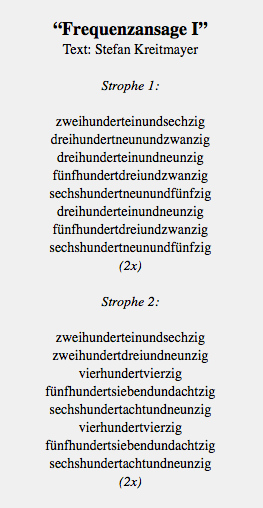
A study in information density made with Csound and the fabulous
MARY TTS
speech generation library.
This is a stereo version of the original 4-channel piece.
Listen to the whole trilogy on SoundCloud.
I designed this shared-screen colour matching game at the University of Sussex to encourage children to treat a tablet as a shared social space. It was later used in research on collaboration and social motor synchrony, including Glass and Yuill's IDC paper on synchronised shared spaces, and their later study of social motor synchrony in autistic peer partners.
This interactive tabletop application allows groups of up to four tourists to plan a day out in Cambridge. It was designed and evaluated by researchers at The Open University and published as a full research paper at the CHI conference in 2011. I contributed the Processing implementation.

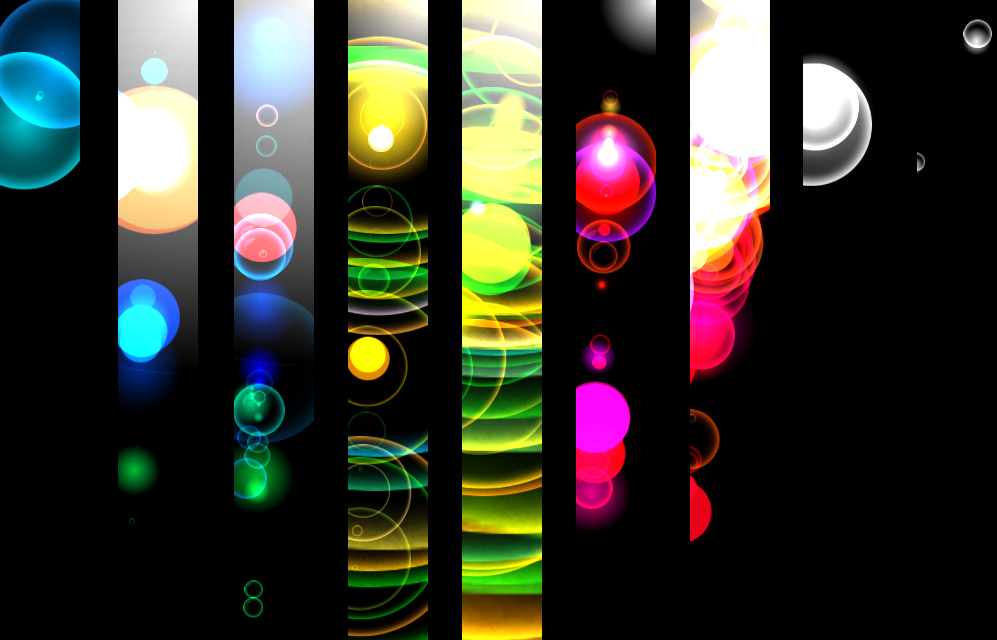
When jazz legends Carla Bley and Steve Swallow played at Philharmonie Essen, Germany, in 2009, I had the honour of designing live visuals for the event. A custom-size projection screen (8 metres) was commissioned, and I brought artists Henrik Lippke and Thamya Rocha into the team. Together we developed a tool — using Processing, Pure Data, and multiple MIDI controllers — to generate free-floating bubbles that could move individually or in dynamic formations, adapt to the music, change their shapes and colours, and leave trails. Following Thamya's artistic direction, Henrik and I performed the visuals along with the music, focusing on very slow-moving systems of colour and light. The video shows the entire concert in fast forward.
Real-time animated fractals surround the audience on a winter evening. Shaped as human figures, roads, or trees, they react to the sound of the audience and occasionally morph into each other. Why shouldn't legs be seen as branches or forks in the road? What makes a forest different from a crowd? Is it just a matter of scale and angle? This work playfully reflects on the concept of self-similarity by extending it from the individual fractal object to the boundaries between types of objects, as well as story elements. The installation took place at an art college surrounded by trees and roads. Implemented in Processing.

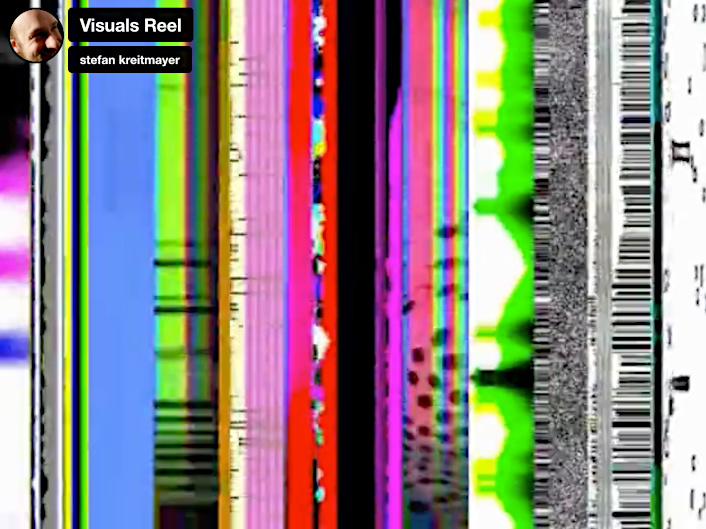
This short video shows a few examples of my visual work in the early 2000s, including commissions and live performances. Everything was created using open-source tools, including openFrameworks, Processing, Blender and ImageMagick.
“Diktator ohne Land” was a studio band active in the early 2000s. Its only album, “Zimt-Artillerie,” was recorded almost entirely in my student bedroom studio and still brings me joy when I listen to it. The band name “Diktator ohne Land” was inspired by the Dalai Lama; “Zimt-Artillerie” was inspired by a harmless baking accident.
